
Meetings come in all kinds of shapes and sizes: coffee chats, walking meetings, daily standups, weekly roundups, 1:1 syncs, town halls, monthly retrospectives, quarterly business reviews, annual general meetings, etc.
Call them whatever you want. Love them or hate them, one thing’s for sure is you can’t avoid them.
While people have different reasons for conducting different types of meetings, this article highlights two of them: daily standups and weekly roundups.
The lifeblood of tech startups
Tech startups have it tough. They not only need to build cool products (that people want), but also launch them fast. On top of that, they need to keep up with industry trends, listen closely to their customers, and innovate where possible. “Move fast and break things” has become a mantra (of sorts) for startup folks.
The lean and agile culture of many startups today has also shaped how meetings are conducted internally. Employees don’t want long drawn intense meetings that occur too frequently. But at the breakneck speed that startups operate on, how do people stay connected with each other while still being hyper productive?
This is where daily standups and weekly roundups come in.
Together, they form the lifeblood of the company – keeping everyone’s fingers on the pulse of things, and staying on course.

“Daily standups. Weekly roundups. Is it too much to ask for both?”
Daily standups – the pulse of things
Daily standups are morning “huddles” where teammates get together (standing up) to share individual updates with everyone else. They’re designed to be quick (15 minutes max), relevant (only important points), and to-the-point (no rambling). While originally used by software/engineering teams for agile development, daily standups have since found its way into other functions due to the benefits the practice provides.
Daily standups are typically done at a team level, although for much smaller startups, it could involve the entire company.
The typical format for daily standups involves each person sharing these three simple updates:
- What did I work on yesterday?
- What am I working on today?
- What issues are blocking my progress?
While seemingly simple a format, these questions have two very powerful effects:
- Sharing progress and small wins brings about excitement and motivation to everyone (something much needed in startups).
- Highlighting blockers keeps everyone grounded and on their toes (no more unpleasant surprises).
So the whole point behind daily standups is this: keep everyone informed, connected, and calibrated to the team’s game plan.
There are many tips and tricks to adopt and pitfalls to avoid when it comes to conducting daily standups that this article will not cover. Suffice to say, when done right, daily standups will not only be extremely meaningful and productive, but fun for everyone.
Weekly roundups – staying on course
Weekly roundups (as per this article’s definition) are not extended versions of daily standups.
While daily standups zoom in on the mirco details (individual tasks and initiatives), weekly roundups zoom out and focus on the larger goals and strategies that the team (or individual) is committed to.
In short, weekly roundups remind everyone why they are doing what they are doing, and align everyone towards common goals – something that should be done regularly in startups since they are more susceptible to directional uncertainty.
Depending on the size of the company, weekly roundups can be conducted in a variety of ways.
For bigger companies, they could be done at a team level where everyone shares their updates (like a daily standup). In smaller companies, they could involve the whole company where only the functional heads or team leader speaks (and everyone else listens). Whatever the case, make sure you keep all meetings as effective as possible.
Once again, it’s important to emphasis that whoever is speaking should focus on overall progress towards larger goals. These could be goals planned out for the month or quarter.
Daily standups vs weekly roundups
Here are (extremely simplified) examples comparing updates shared during daily standups vs weekly roundups.
| Daily Standup |
| Jane the Content Manager “I finished designing the infographic yesterday. Today I’m starting on a new blog post. A potential blocker is getting research data from one of our customers needed for the article.” |
| Tom the Frontend Engineer “Yesterday I started scoping out the specs needed for the new web feature that allows users to generate reports at a click of a button. Today coding work begins and I anticipate this will take me 2 days before I hand it off to QA for testing. No blockers for now.” |
| Rex the Sales Development Rep “I spent the whole of yesterday generating leads on LinkedIn. I managed to find 85 leads. Today I’ll be qualifying and filtering them based on our sales criteria. My current blocker is that I’m still waiting for my manager to give me the updated set of criteria!” |
| Weekly Roundup |
| Tim the VP of Marketing “The marketing team published 3 out of 10 new blog posts, along with 2 out of 3 infographics targeted for the quarter. We have seen our social media engagement and web traffic increase by 11% and 9% respectively, which is almost halfway through out quarterly goals. Overall as a team we’re at 34% of our marketing goals. |
| Rob the Head of Engineering “The product team has shipped 2 new features with 3 more to go. Reported bugs had increased by 7% though. This will create a bottleneck for us for our next feature. Our team is already behind schedule for the quarter. We’ll be working closely with the QA team later this week to see how we can optimize our feature release processes better.” |
| Sharon the Sales Director “Last week, the SDR team generated a total of 384 leads, which is 38% of our 1,000 lead target. We managed to secure a 12 meetings with potential customers ,bringing our sales pipeline to $128,000 for the quarter. This is about 48% of our target this quarter. We have yet to close a single deal, so that’s quite worrying. I’ll be meeting with the sales team later this afternoon to see how we can accelerate some late stage deals. We aim to close one by next week.” |
As you can see from the the above examples, conversations in weekly roundups are vastly different from those in daily standups. They are more “forward thinking” and strategic. They talk not just about metrics but the implications behind them. Most importantly, they tie everything back to the larger goals previously agreed upon.
When it comes to goal setting, OKRs (Objectives & Key Results) are great and highly recommended for startups to use for weekly roundups. This is because OKRs are designed to be “agile” by nature, enabling individuals and teams to zero in on top priorities and goals, while giving enough time and flexibility for pivots and course corrections. They are also simple to understand and easy to implement (so long as you do it right).
(In this context, specific tasks and initiatives discussed during daily standups represent components and drivers of an Objective’s Key Results, which in turn are discussed during weekly roundups. See image below.)
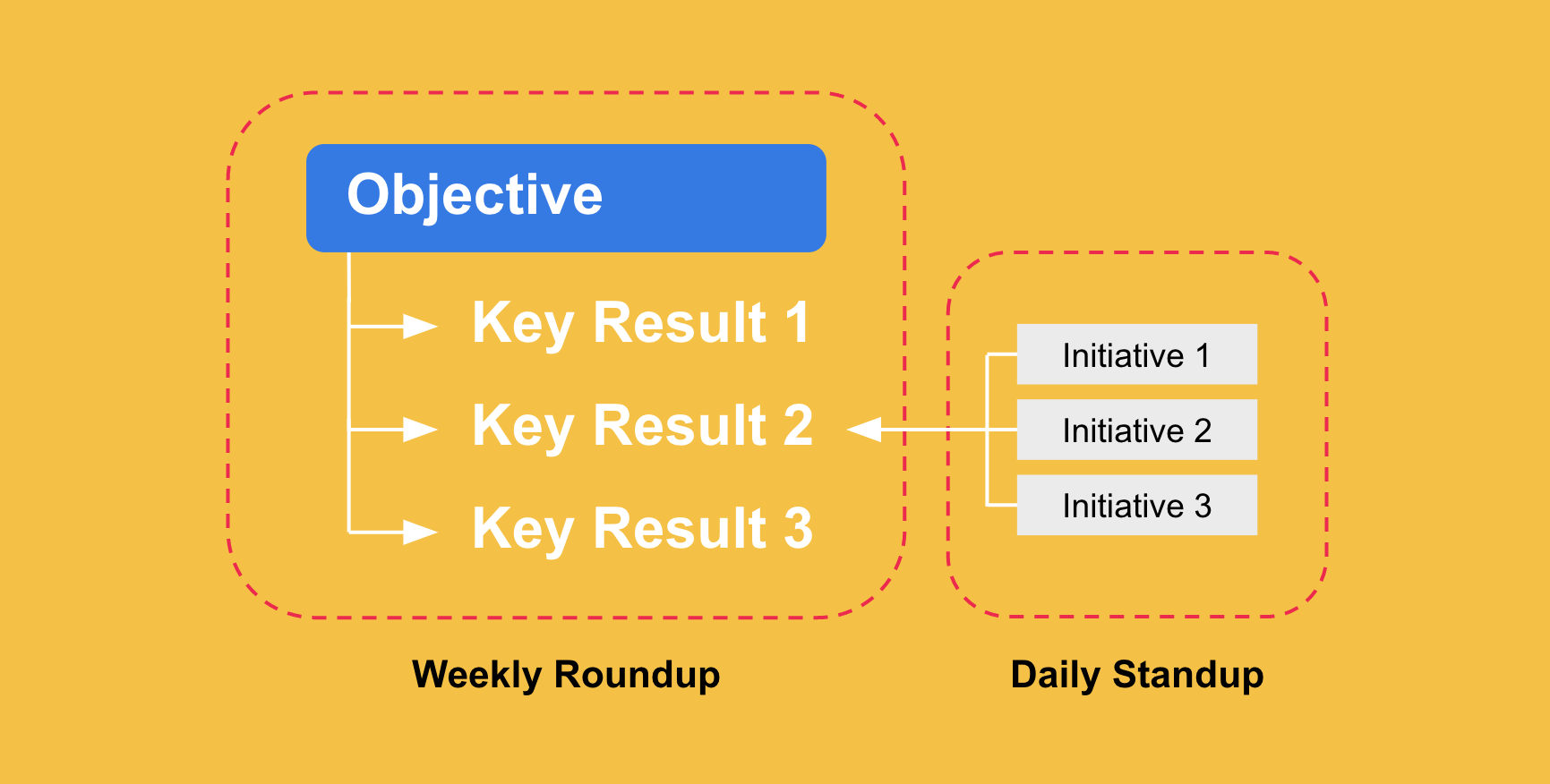
How OKRs can fit into your meeting structure
Summary: Powerful allies for growth
Now that you understand what daily standups and weekly roundups are about and their differences, it should be clear how pairing the two together can be extremely powerful.
Daily standups provides detailed insights into the specific tasks and initiatives, while weekly roundups gives everyone a reality check of how teams are progressing towards overall goals committed to.
This daily and weekly cadence is where the power lies. Everyone is kept accountable to their tasks on hand without ever losing sight of the larger goals and vision of the company. Any issues or blockers are detected early and appropriate actions are carried out to resolve them quickly.
Essentially, this cadence allows your organization to move fast and hopefully not break (too many) things.
So if you’re a tech startup seeking powerful growth, and have yet to pair daily standups and weekly roundups together, give it a shot. It could be the game changer your startup needs.
SugarOKR is a beautifully simple and easy-to-use free OKR management tool that helps teams unlock the full potential of OKRs, while staying focused and motivated. To find out how your company can win with OKRs, visit us at sugarokr.com.
Want to connect your standups to OKRs and performance reviews?
SugarOKR is free. Align your daily work to company goals in 30 minutes. Now part of Happy5, the full performance management platform.