 |
Get Started Free → |
What Makes a Performance Review Fair?
Most reviews reward the people who are best at describing their work, not the ones who did the best work. Here is how proof of work fixes that, and why the tool you use decides whether it happens.
| Start Free — No Credit Card → | See Happy5 Demo |
✓ Free forever · ✓ Set up in 30 minutes · ✓ Upgrade only when ready
| Related reading: | What is OKR? | Lattice Alternative | Culture Amp Alternative |
Here is a pattern most People leaders recognize. Two people on the same team have a similar year. One writes a sharp self-review, name-drops the right projects, and reminds their manager of every win. The other quietly shipped more, said less, and trusted the work to speak for itself.
Guess who tends to score higher.
This is the fairness problem at the center of performance reviews. When the evidence is not captured through the year, reviews fall back on memory and on how well someone advocates for themselves. That is not the same as measuring who did the best work, and everyone in the room knows it.
The fix is not a better review form. It is proof of work: a running record of what people actually did, connected to the goals it moved, built up over the year instead of reconstructed at the end of it.
Four Reasons Good Work Goes Unrewarded
None of these are about effort or talent. They are about what the review process can actually see.
|
🧠
Recency BiasThe last six weeks overwrite the first ten months. A strong Q1 fades from memory while a rough recent sprint dominates the conversation, simply because it is easier to recall. |
🗣
The Self-Promotion GapConfident writers get better reviews than quiet doers. When the record is thin, the person who describes their work best wins — not the person who did the most of it. |
|
🔄
Disconnected DataGoals live in one tool, the actual work lives in another, and the review lives in a third. Nobody can see the full picture in one place, so managers rebuild it from scratch every cycle. |
⏳
The Two-Week ScrambleBefore review season, managers can lose up to two weeks just gathering proof of what their teams did. Under that time pressure, the quiet high performers are the easiest to overlook. |
Proof of Work, Explained Simply
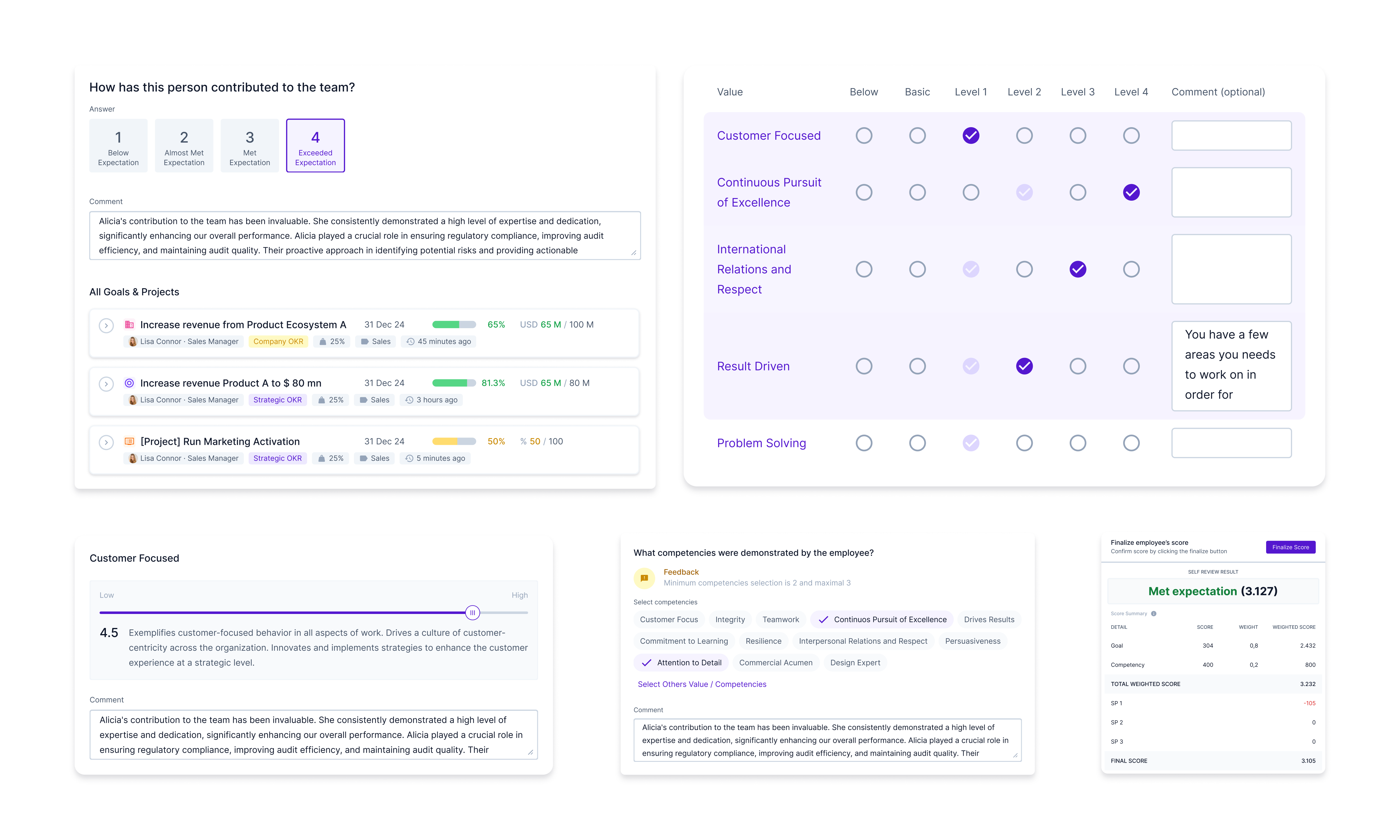
(Proof-of-work in our premium platform, Happy5)
Proof of work means the evidence of what someone contributed is captured as it happens, not remembered at the end. It has two halves, and fair reviews need both.
Outcome — the OKRsThe results a person was aiming for and how far they moved them. This is the impact: did the number change, did the goal advance, did the outcome land. |
Output — the workThe projects, tasks, and shipped work behind those results. This is the effort and delivery: what actually got built, run, or fixed along the way. |
Put outcome and output side by side and a review stops being a memory test. You can see the whole year in one place: what someone set out to do, what they shipped, and what changed because of it. That is what fair looks like, and it is only possible when goals, work, and reviews live in one connected system instead of three separate ones.
Memory-Based Reviews vs Proof-of-Work Reviews
| Memory-Based Review | Proof-of-Work Review |
| Evidence reconstructed from memory in the final two weeks | Evidence captured continuously as work happens |
| Rewards the best self-promoters | Rewards the strongest contributors |
| Goals, work, and reviews in separate tools | Goals, work, and reviews in one connected view |
| Quiet high performers get overlooked | Quiet high performers are visible on the record |
| Managers dread review season | Review season is a summary, not a scramble |
Start With Goals. Grow Into Fair Reviews.
SugarOKR is free forever for OKR tracking, so the outcome half of proof of work is captured from day one. Every objective and key result, updated as the quarter runs. New to OKRs? Start with our complete guide to what OKRs are.
When you are ready to connect the output half, the projects and work behind those results, and turn it into review-ready evidence. Happy5 brings goals, project work, and performance reviews together in one platform. The proof builds up through the year, so reviews reflect what people actually did instead of what they remembered to write down.
That is the whole idea: fairer reviews, because the evidence was there all along.
Make your next review season fairer
Start capturing proof of work today with free OKR tracking. Upgrade to connected reviews with Happy5 whenever your team is ready.
| Start Free → | Book a Happy5 Demo |
Frequently Asked Questions
What does “proof of work” mean in performance reviews?
It means the evidence of what someone contributed is recorded as the work happens, the outcomes they moved and the projects they delivered, so the review is based on a real record rather than end-of-cycle memory.
Why are traditional performance reviews considered unfair?
Because they lean on memory and self-promotion. Recency bias favors the last few weeks, and confident self-reviewers score higher than quiet high performers, even when the quiet ones did more.
What is the difference between outcome and output?
Outcome is the result you were aiming for, tracked as OKRs. Output is the actual work delivered to get there, the projects and tasks. Fair reviews need both, seen together.
Can I start for free?
Yes. SugarOKR is free forever for OKR tracking, which captures the outcome side of proof of work. When you want project work connected to review-ready evidence, Happy5 brings it all together in one platform.
SugarOKR by Happy5 — free OKR tracking, fair performance reviews.
© 2026 Happy5. sugarokr.com